Technic Enterprise & Technology · Samut Prakan, Thailand
In-Process Parts for Semiconductor and Photonics Assembly: Nozzles, Collets, Fixtures and Test Sockets
The small parts that touch the die, the fiber and the package on every cycle: pick-up nozzles, ejector pins, window clamps, V-groove fixtures, PEEK test sockets. Precision-machined in Thailand to ±0.005 mm, with ±0.002 mm where the process demands it. Quotation within 3 working days.
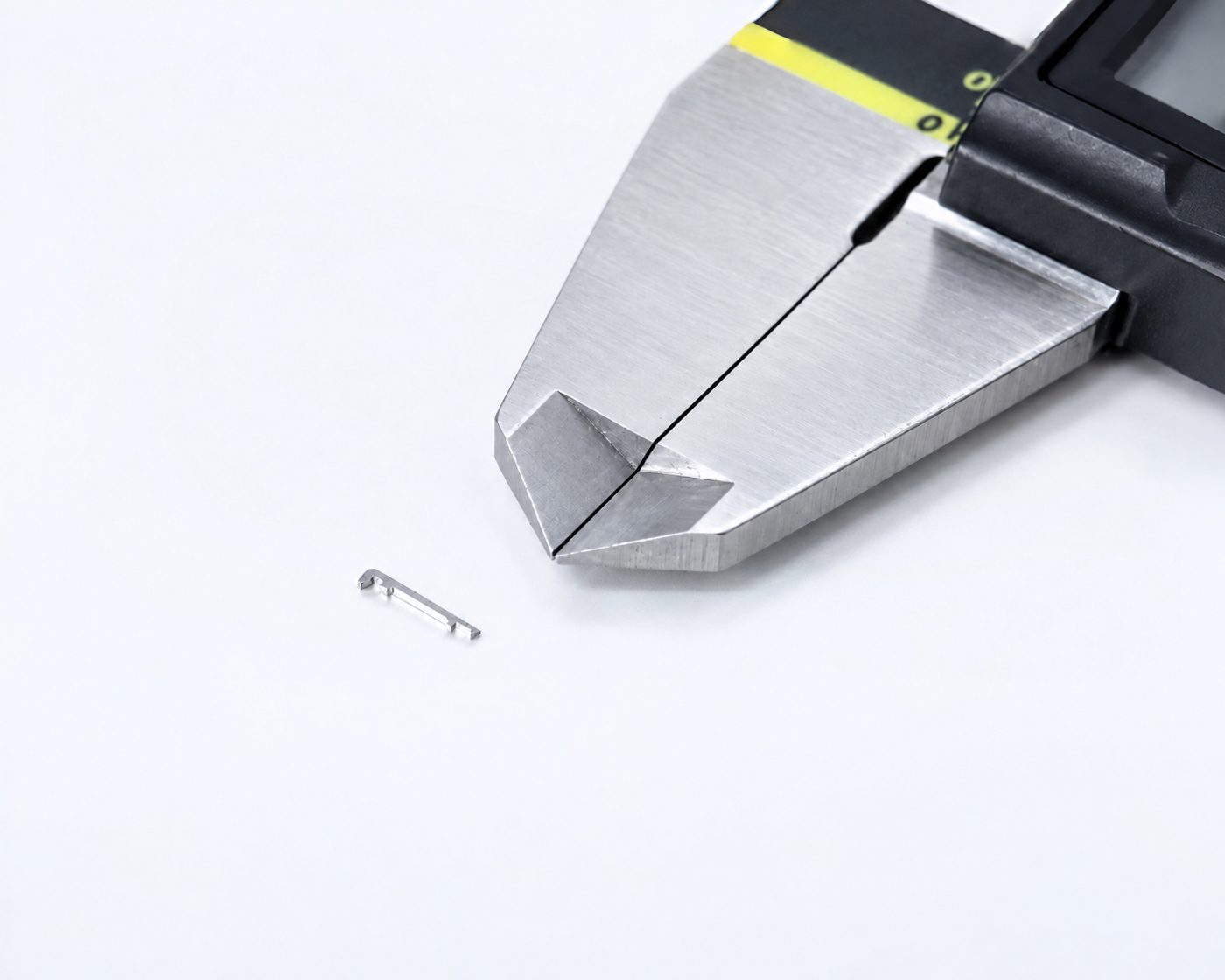
What are in-process parts, and why they decide your yield
In-process parts (also called indirect materials, MRO tooling or consumable tooling) are the components on a production line that handle the product without becoming part of it. A pick-up nozzle lifts a laser diode die a few hundred microns wide. A window clamp holds a lead frame flat while gold wire is bonded. A V-groove fixture holds a 125 µm optical fiber still while it is aligned to a lens to sub-micron accuracy. None of these ship inside the transceiver, but every one of them touches the product on every cycle.
Because they wear, they are re-ordered continuously. Because they hold the product, their tolerance and surface condition set the yield of the step they serve. A nozzle tip that is 5 µm out of square tilts every die it places. A burr on a clamp scratches every substrate. This is why equipment engineers, process engineers and indirect procurement teams at semiconductor and photonics plants keep a short list of machine shops who can hold these tolerances repeatably, deliver in weeks, and document every lot.
Technic Enterprise has machined this class of part for hard-disk-drive, semiconductor and automation lines in Thailand since 2000. Below is the range we manufacture to your drawing, organised by the process step each part serves.
Die attach and die handling
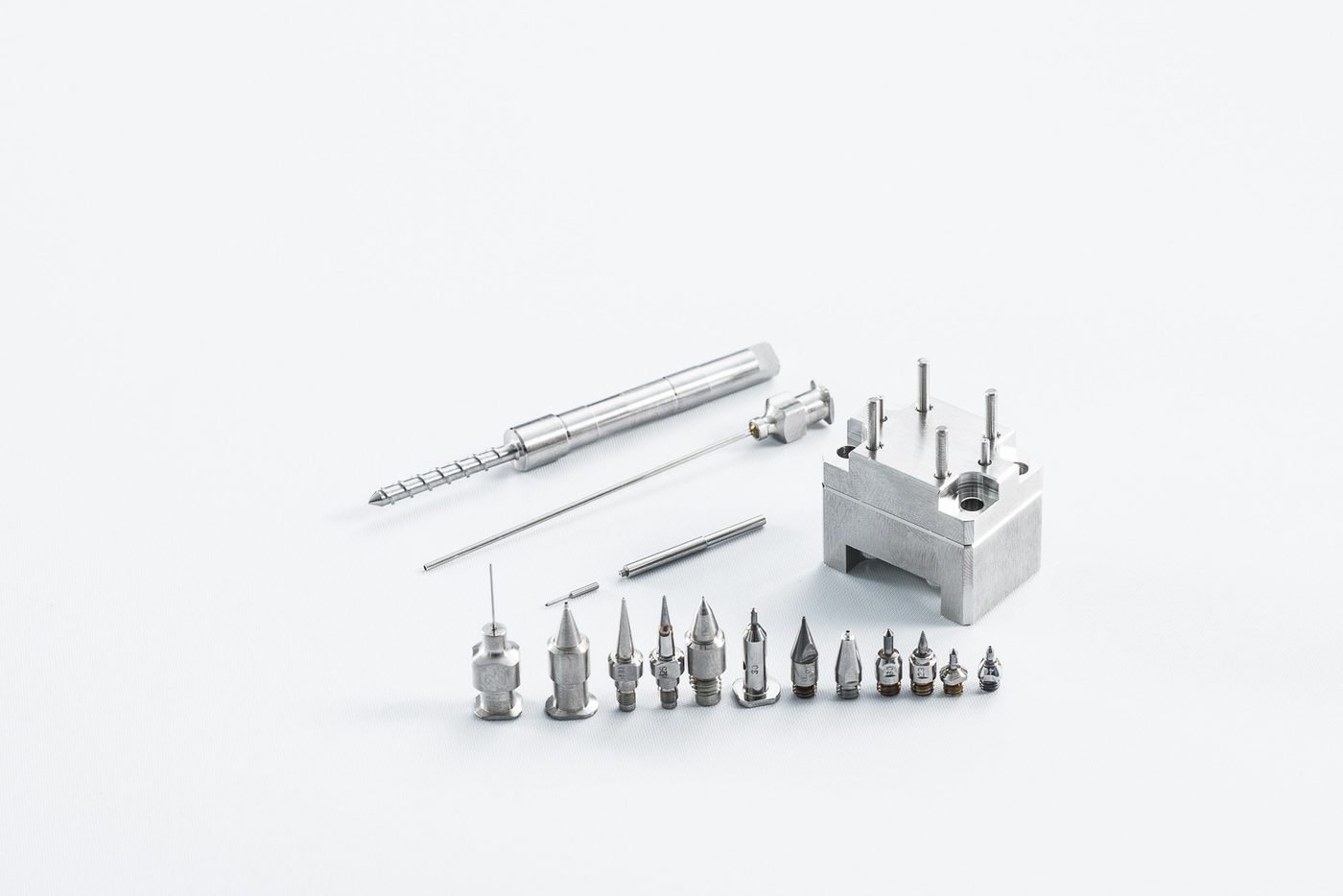
After dicing, each die is pushed up from the dicing tape by an ejector needle, lifted by a vacuum nozzle or collet, and placed onto a substrate, header or carrier. Tip flatness, hole concentricity and edge condition decide whether the die arrives level and uncracked.
Vacuum tip that lifts the die. Tip face ground flat and square to the bore; small vacuum bore; wear-resistant material for millions of cycles.
Tungsten carbide · SUS440C · PEEK tip
Fine hardened needle that pushes the die off the tape from below. Tip radius and surface finish control cracking of thin dies.
SUS440C hardened · Tungsten carbide
Cap and holder that carry one or several needles in a precise pattern under the tape.
SUS303 · SUS304
Multi-cavity carrier that locates substrates or headers through dispensing, placement and oven cure. Cavity position held to ±0.005 mm.
Aluminium A6061 · Stainless steel
Flat plate with arrays of small vacuum holes holding wafers, substrates or trays. Flatness and hole pattern by micro-drilling.
Aluminium A6061 · Stainless steel
Pins that transfer a controlled dot of die-attach epoxy, and holders for dispensing needles.
SUS303 · Tungsten carbide
Wire bonding
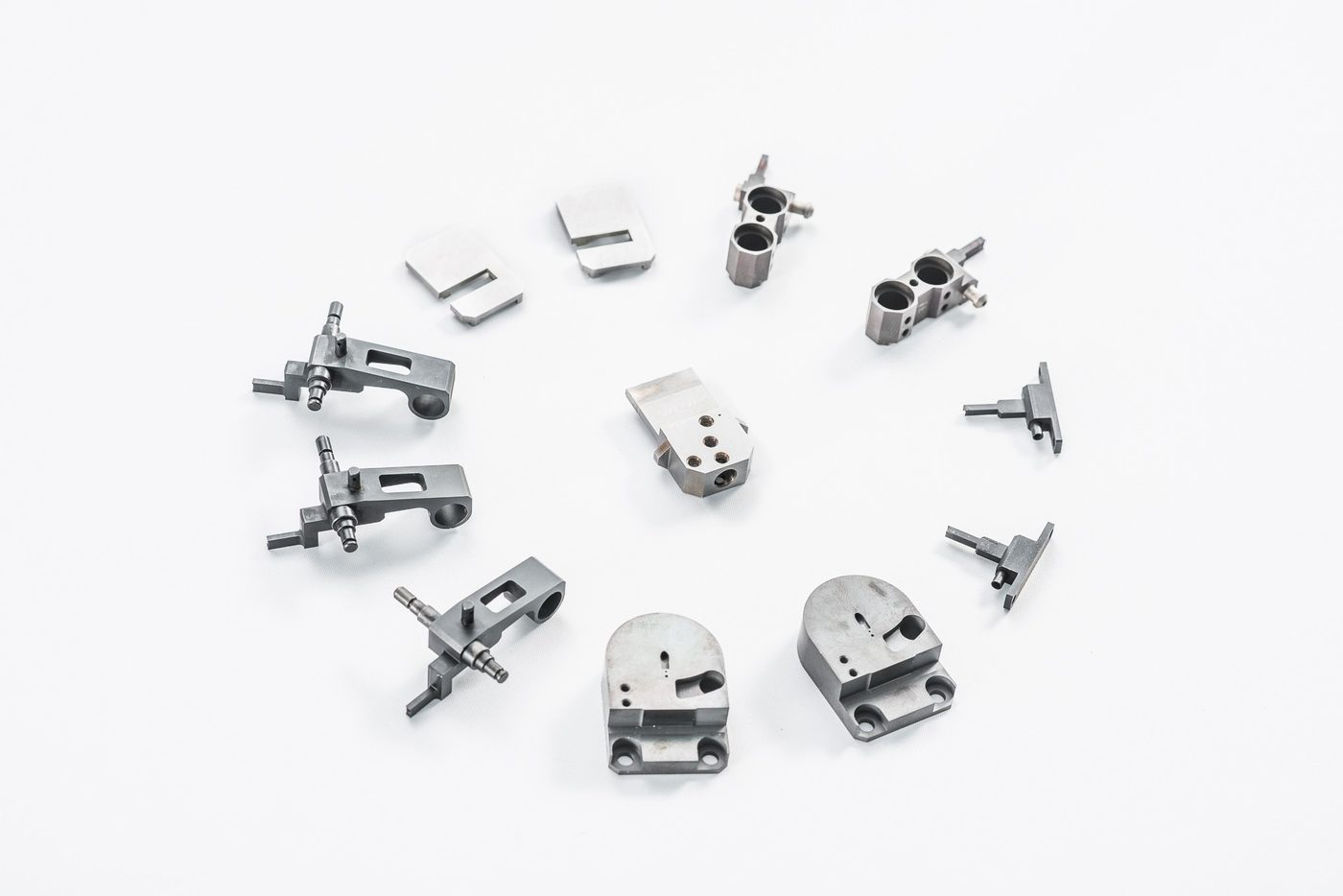
The lead frame or substrate is clamped against a heated stage while gold or copper wire is bonded. The clamp window, heater block insert and work holder must be flat, burr-free and hard enough to survive years of clamping.
Hardened plate with a precisely cut window that presses the lead frame flat around the bond pads. Sharp, burr-free window edges by wire EDM.
SKD11 hardened · Tungsten carbide
Insert under the substrate that carries heat and supports the bond. Flatness and parallelism by surface grinding.
Hardened tool steel · Tungsten carbide
Fixture that indexes packages or strips under the bond head, with locating pins to ±0.005 mm.
SUS304 · Aluminium A6061
Hot-bar reflow soldering
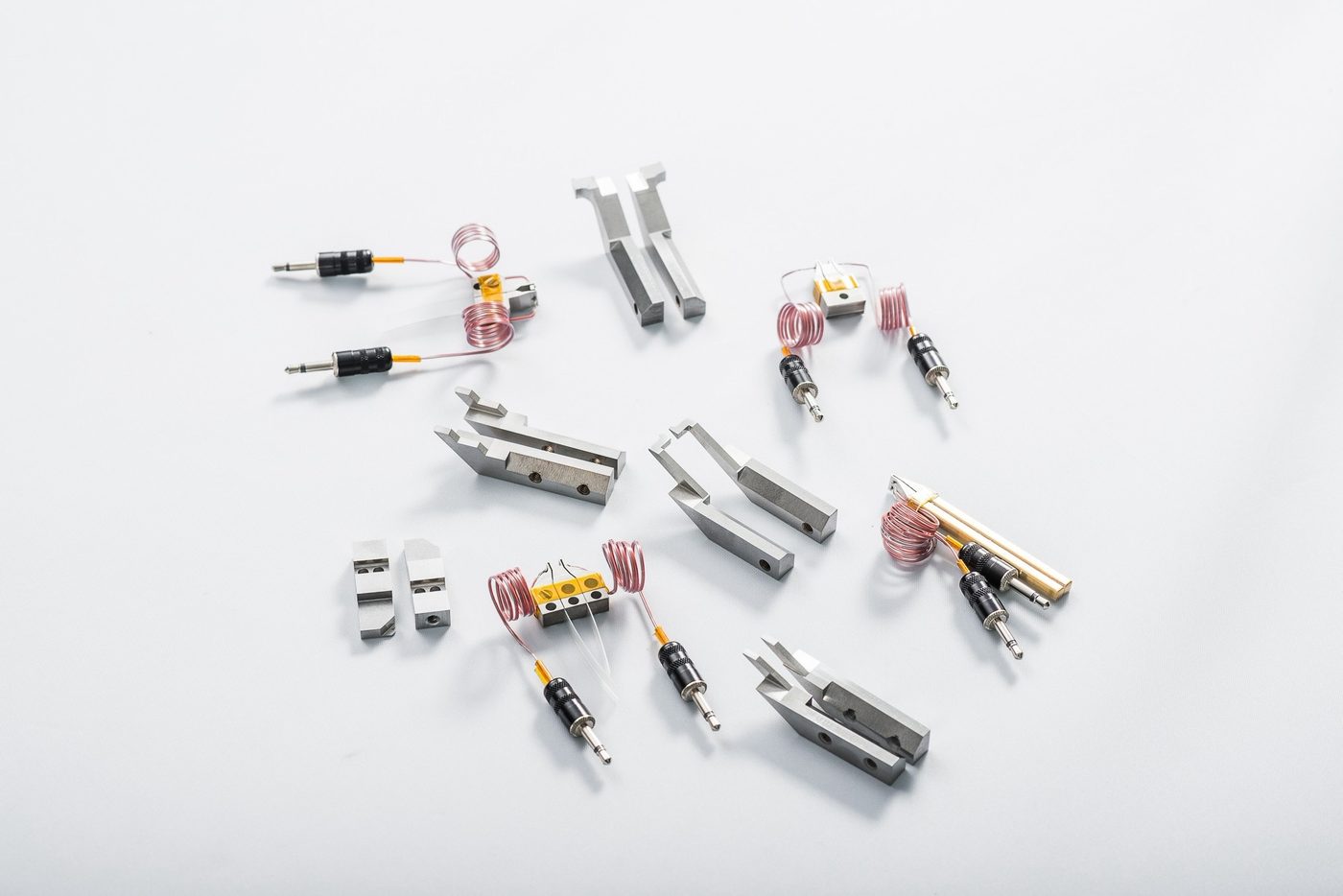
Flex circuits are soldered to the module or head by a heated tip that presses the joint and reflows the solder in one pulse. The tip carries an embedded thermocouple so the controller can hold the pulse profile; tip flatness and the position of the thermocouple decide joint quality.
Heated pressing tip with a thermocouple embedded next to the working face. Working face ground flat and parallel; supplied assembled with lead wires and plug.
Copper alloy · Hardened tool steel · PEEK (insulating versions)
Copper-alloy bar that carries current and heat to the tip, with the mounting features of the bonding head.
Copper alloy
Fixture that holds the flex circuit and module in register under the tip.
Aluminium A6061 · PEEK
Fiber and lens alignment (photonics)
In an optical transceiver or optical sub-assembly (TOSA / ROSA), a laser, a lens and a single-mode fiber must be aligned to within a fraction of a micron, then fixed by UV-cure epoxy or laser welding. The fixtures that hold each element during active alignment are the most demanding in-process parts on the line.
Hardened block with a V-groove that seats a 125 µm fiber on two lines of contact. Groove position and angle cut by fine-wire EDM and finished by grinding.
SUS440C hardened · Tungsten carbide
Clamp that holds a 4- to 16-fiber ribbon flat and parallel during array alignment.
Stainless steel · PEEK
Holder for Ø1.25 mm (LC) or Ø2.5 mm (SC/FC) ceramic ferrules. Bore concentricity held on the Swiss-type lathe.
SUS303 · Copper alloy · PEEK
Soft-jawed tip or nest that holds a 0.5–3 mm lens during active alignment without marking the surface.
PEEK · Stainless steel
Hardened finger pair on the multi-axis alignment stage that grips the sub-assembly. Our most-requested part type; jaw geometry held to ±0.002 mm.
SUS440C hardened · Tungsten carbide
Nest that keeps the aligned assembly fixed while the adhesive cures under UV. Black-anodised aluminium on request.
Aluminium A6061 · Stainless steel
Clamp that holds the TOSA/ROSA housing and fiber sleeve during laser welding; copper alloy versions for heat sinking.
SUS304 · Copper alloy
Precision pins that reference every fixture to the machine datum.
SUS440C hardened · Tungsten carbide
Package assembly and sealing
Once aligned, the assembly goes into a TO-can, butterfly or surface-mount package. Fixtures locate lid and base for sealing; dies trim and form the package leads.
Nest that holds base and lid in register during seam sealing or adhesive sealing.
SUS304 · Aluminium A6061
Punch and die set that trims and bends TO-46 / TO-56 header leads. Cutting edges by wire EDM to ±0.002 mm.
Tungsten carbide · SKD11
Tooling for forming thin metal lids and frames.
SKD11 · Tungsten carbide
Test and burn-in
Every finished device is electrically and optically tested, and many are burned in at temperature. Sockets and carriers must locate the part repeatably thousands of times without wearing the leads or the optics.
Engineering-plastic socket that locates a TO-can or TOSA for probing. Cavity position ±0.01 mm; PEEK for temperature and dimensional stability.
PEEK · Aluminium A6061
Plate with arrays of small precision holes carrying spring probes. Hole pattern by micro-drilling.
PEEK · Copper alloy
Multi-position carrier that holds devices through burn-in ovens.
Aluminium A6061 · PEEK
Block that receives LC / MPO connectors on the optical test station in fixed alignment.
Aluminium A6061 · Stainless steel
Copper-alloy block that holds the device at test temperature.
Copper alloy · Aluminium A6061
Holders for cleaver blades and ferrule end-face polishing jigs.
SUS440C hardened · SKD11
Automation and material handling
Between stations, robots and conveyors move trays, strips and modules. End-of-arm tooling and locators wear and are replaced on schedule.
Custom fingers for parallel grippers handling modules, trays or strips.
Aluminium A6061 · Stainless steel · PEEK
Nest that registers JEDEC trays to the machine datum.
Aluminium A6061
Hardened blocks and stops that set position on conveyors and indexers.
SUS440C hardened
Guides and blades for tape-and-reel and strip feeders.
Stainless steel · Tungsten carbide
Materials and tolerances we hold
| Item | Capability | Notes |
|---|---|---|
| Standard tolerance | ±0.005 mm | In the specified process |
| Process-level tolerance | ±0.002 mm | Wire EDM, surface grinding, 6-axis Swiss-type turning |
| Surface finish | Ra 0.4 | Ground and finished surfaces |
| Smallest EDM wire | Ø0.1 mm | Fine-wire cutting for narrow slots and V-grooves |
| Materials | Tungsten carbide, hardened tool steel (SKD11, S45C), stainless (SUS303, SUS440C), beryllium copper, copper alloy, aluminium A6061, Haynes 230 superalloy, PEEK and engineering plastics | Material supplied by us or free-issued by you |
| Processes | Turning (incl. 6-axis Swiss), milling, wire EDM, sinker EDM, grinding, micro-drilling | All six in-house, one factory |
| Inspection | Non-contact video measuring system, 0.5 µm resolution | 100% inspection with report on request; 80 calibrated instruments |
| Quality system | ISO 9001:2015 | Certified since 2000 (URS / UKAS) |
What to specify on the drawing
Three details on your drawing shorten the quote cycle and prevent the failures we see most often on in-process parts.
State “burr-free” and the maximum edge break on any surface that touches the die, fiber or substrate. We deburr under magnification and can supply edge photos with the lot.
For nozzle tips, clamp faces and heater inserts, call out flatness and squareness to the bore or datum face. These are ground, not just milled.
Tell us if the part enters a clean assembly area. We ultrasonic-clean, dry and bag individually so no cutting fluid reaches your line.
How to order
Send the drawing (PDF or STEP) with quantity and target delivery to the address below. NDA on request before you send.
We return a quotation within 3 working days, with any suggestion that reduces cost without changing function.
First article ships with a full dimensional report from the video measuring system. Standard lead time 2–4 weeks.
For repeat parts, our Buffer Stock Program holds finished stock against your blanket order and ships in 1–2 days on call-off.
Frequently asked questions
Do you machine tungsten carbide nozzles and collets?
Yes. Carbide tips and collets are produced by EDM and grinding in-house, with tip faces ground flat and square to the vacuum bore.
What is the smallest feature you can cut by wire EDM?
We run wire down to Ø0.1 mm for narrow slots, clamp windows and V-grooves, holding ±0.002 mm on the wire-cut features.
Can you supply PEEK test sockets and fixtures?
Yes. PEEK and other engineering plastics are machined regularly for test sockets, pogo-pin holders, burn-in carriers and lens nests.
Do you provide inspection reports?
Every first article ships with a dimensional report from our non-contact video measuring system (0.5 µm resolution). 100% inspection with per-piece reports is available on request.
What quantities do you take?
From prototype quantities of a few pieces to repeat production lots. For consumable parts re-ordered every month, the Buffer Stock Program keeps finished parts on our shelf against your forecast.
Where are you located?
Samut Prakan, next to Bangkok, Thailand. We ship to plants in Thailand and export to Singapore, China and Mexico.
Part names above are generic process terms. Customer part numbers, drawings and applications are never disclosed.